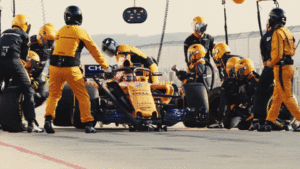
Miami delivered exactly what modern F1 promises: sunshine, celebrities pretending they understand tyre strategy, and absolute chaos wrapped in carbon fibre. We got a breakout star casually building a championship résumé, McLaren rediscovering competence (shocking, I know), Red Bull experimenting like it’s a science fair, and Ferrari… well… Ferrari-ing.
But underneath the spectacle, something far more important happened—
The balance of power shifted.
And at the centre of it all? A teenager who is starting to look alarmingly inevitable.
Let’s get into it.
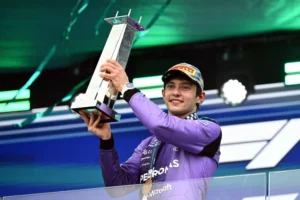
Kimi Antonelli: The Teenager Who Forgot He’s Supposed to Be Nervous
At this point, calling Kimi Antonelli “promising” feels like calling a rocket launch “a mild inconvenience.” The man (child?) just won his third consecutive race and extended his championship lead like it’s a casual Sunday drive. Miami wasn’t a walk in the park either. He had pressure from both McLarens, strategy swings, safety cars, and enough chaos behind him to qualify as a disaster movie. Still, he held on, controlled the race, and did that thing elite drivers do—make very stressful situations look mildly annoying instead of career-ending.
Let’s pause here.
He is 19. On a three-race winning streak Leading the championship Converting poles into wins like it’s a checklist
The way he managed Norris in the closing stages—keeping just enough gap without overcooking tyres—wasn’t rookie behavior. That was “future multi-time world champion who will ruin your favourite driver’s hopes and dreams” behavior.
So yes, the question is no longer if he’s a title contender. It’s how long before the rest of the grid starts forming a support group.
This wasn’t a dominant, lights-to-flag cruise where he disappears into the distance like a 2023-era Max Verstappen highlight reel. No, this was far more telling. He had constant pressure from two McLarens, strategy variables shifting mid-race and Safety Car interruptions threatening rhythm. And through all of that, he looked… calm. Almost suspiciously calm. There’s a specific moment late in the race where Lando Norris starts creeping into DRS range. This is usually where young drivers either push too hard and cook their tyres or simply just crack under pressure and make a msitake.
Antonelli did none of those things.
Instead, he controlled the gap like a seasoned champion—managing pace, deploying battery at the right moments, and never giving Norris a real shot. It wasn’t flashy. It was clinical.
That’s the scary part.
He’s not just fast—he’s complete. The wildest part? He’s still improving. Which means the rest of the grid isn’t chasing his peak—they’re chasing a moving target.
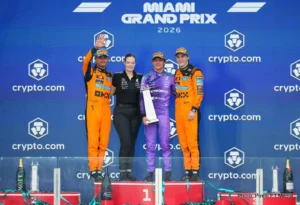
McLaren: From “We Tried” to “We’re Actually a Problem Now”
McLaren showed up in Miami like someone who just discovered the gym… and immediately got jacked. A Sprint race 1-2 finish followed by P2 and P3 in the main race tells you everything you need to know, they’re not back—they’re dangerous.
Lando Norris pushed Antonelli all race long, finishing just a few seconds behind. Not close enough to win, but close enough to say, “We’re coming.” His pursuit of Antonelli wasn’t desperate—it was controlled, measured, and strategic. He knew he had the pace, and for once, the car backed him up.
Meanwhile, Oscar Piastri quietly did what Piastri does—hover near the front, strike late, and steal podiums like a polite assassin. Piastri—the human embodiment of “quietly excellent.” While Norris grabs headlines, Piastri just keeps stacking results like a guy who’s already read the script.
What’s changed?
Upgrades. Proper ones. Not the “we found 0.03 seconds but lost 0.2 everywhere else” kind. Actual, meaningful performance gains. And suddenly, Mercedes has competition. Real competition. The car now carries speed through corners without eating tyres alive and has some good straight-line competitiveness.
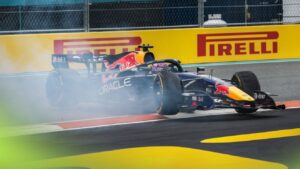
Red Bull & Max Verstappen: Fast… but Slightly Confused?
Let’s talk about Red Bull, because this one’s interesting. On paper: upgrades, improved pace, Verstappen starting near the front. In reality: spins, penalties, strategy headaches, and a general vibe of “we’re figuring it out, okay?” Max’s race was… chaotic. Early spin dropped him down the order, and as expected we got the soon to be trademarked Max Recovery Drive.
He still dragged the car to P5, because he’s Max Verstappen and physics occasionally bends around him.
But Red Bull’s bigger story is that new rear wing concept—a shiny upgrade that promises performance but hasn’t fully delivered consistency yet. But the pace is there and the added max performance means they definitely clawing their way into this championship fight. The upside for Red Bull is that the raw pace is there. When the car clicks, it’s still one of the fastest on the grid. The problem? It doesn’t click often enough.
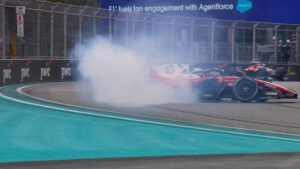
Charles Leclerc: A Masterclass… Followed by a Meltdown
There are race weekends where everything goes wrong from the start. This was not one of those for Charles Leclerc. Which somehow makes what happened even more painful. For most of the race, Leclerc was fast, controlled and strategically sound. He was on track for an easy podium. Everything looked… stable.
And then came the final lap.
In what can only be described as a “Ferrari cinematic universe moment,” things unravelled at an almost artistic pace. A mistake under pressure (most likely due to tyres so cooked they needed a dippign sauces). Then contact with the wall, after a heroic spin. The damage that clearly affected handling, followed multiple off-track excursions, had positions lost in rapid succession. His prize? A 20-second penalty for good measure
It was chaos. Beautiful, tragic chaos.
Now, to be fair, he was driving a damaged car. But Formula 1 has never been particularly sympathetic,
The stewards looked at the situation and essentially said:
“Unfortunate. Still illegal.”
And just like that, a strong, well-executed race turned into a statistical disaster. The most frustrating part? This wasn’t about lack of pace. It wasn’t about strategy. It wasn’t even about Ferrari making a terrible call (for once). It was a single moment. But in Formula 1, single moments define seasons. And for Leclerc, Miami might end up being one of those races we look back on and say: “That’s where it slipped.”