Let’s get one thing straight right out the gate: Darth Maul is not just “that red guy with the double lightsaber.” That’s like calling a Ferrari “a car with wheels.” Technically accurate, but wildly disrespectful. Introduced in Star Wars: Episode I – The Phantom Menace, Maul had roughly 15 minutes of screen time, spoke about as much as a background extra, and still managed to become one of the most iconic villains in the entire Star Wars universe. Why? Because he looked terrifying, fought like a demon on espresso, and had a presence that screamed, “I could absolutely ruin your day and your Jedi Order.” And yet… he was cut in half and tossed down a pit like last week’s leftovers.
Thankfully, like any good Sith (and apparently every major character in Star Wars), death is more of a suggestion than a rule. Maul clawed his way back through animated series like The Clone Wars and Rebels, slowly transforming from a silent assassin into a deeply layered, vengeance-fueled, trauma-soaked anti-villain, which brings us to Maul on Disney+. Or, as it should be called: “Oops, We Forgot This Guy Was Incredible for 20 Years.”

Fan Favourite Energy (a.k.a. The Boba Fett Effect)
Maul belongs to a very exclusive club of characters who became legendary despite barely being used properly. Right up there with Boba Fett—a man whose original trilogy contribution was mostly standing menacingly and then accidentally falling into a pit.
Fans have been begging for more Maul for years. Not politely, mind you. This has been a full-blown, foam-at-the-mouth demand. And Disney, after testing the waters with other shows, finally gave in and said, “Fine. Here’s your angry, tattooed chaos goblin. Enjoy.”
And oh, we do.
Animation Style: Dark, Stylish, and Slightly Unhinged (In a Good Way)
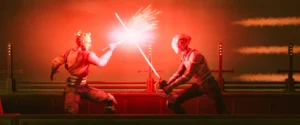
The first thing that hits you about Maul is the animation. This isn’t your Saturday morning cartoon vibe. This is “someone gave a team of artists emotional trauma and a lighting budget.” The show builds on the stylised look of The Clone Wars, but cranks everything up—sharper edges, deeper shadows, more dramatic lighting. Every frame looks like it’s one bad decision away from becoming a heavy metal album cover.
Maul himself is animated with an intensity that feels almost uncomfortable—in the best way. His movements are deliberate, predatory. When he’s still, he’s too still. When he moves, it’s fast, violent, and purposeful. You don’t watch Maul. You brace for him.
There’s also a noticeable cinematic quality to the direction. Long pauses, close-ups that linger just a bit too long, and fight scenes that feel less like action sequences and more like therapy sessions with lightsabers.
The Story: Revenge, Power, and a Whole Lot of Emotional Damage
If you came into this expecting non-stop lightsaber fights and cool poses, don’t worry—you get those. But what Maul really delivers is something far more interesting: a character study of a man who is essentially powered by spite. The series dives deep into Maul’s psyche. This is not a happy individual.
This is a man who has been:
- Trained as a weapon
- Betrayed by his master
- Literally cut in half
- Left to survive out of pure rage
And somehow, he’s still functioning. Barely. But functioning.
The show explores his attempts to rebuild power in the galaxy, navigating crime syndicates, manipulating allies, and constantly battling his own obsession with revenge—particularly against Obi-Wan Kenobi, who lives rent-free in his head at all times. What makes the story compelling is that Maul isn’t just evil for the sake of it. He’s broken. He’s driven. He’s terrifyingly focused. And occasionally—very occasionally—you almost feel bad for him. Almost.
Then he murders someone and you remember, “Ah yes, Sith. Right.”
Tone: Surprisingly Mature (and Just a Little Bit Uncomfortable)
This is easily one of the darkest animated projects in Star Wars. Not in a “look how edgy we are” way, but in a “wow, this character desperately needs therapy and a nap” way. There’s a heavy emphasis on internal conflict, identity, and purpose. Maul isn’t just fighting enemies—he’s constantly fighting himself, his past, and his inability to let anything go. Ever.
The pacing reflects this. It’s not a non-stop action sprint. It’s slower, more deliberate, giving scenes time to breathe—and sometimes suffocate you emotionally.
And when the action does hit? It hits hard. Brutal, fast, and often over before you’ve processed what just happened. Which feels very on-brand for Maul.

Supporting Cast: Everyone Else Trying Not to Die
While Maul is obviously the centrepiece, the supporting characters do a great job of orbiting his chaos without being completely overshadowed. Crime lords, mercenaries, and unfortunate souls who thought working with a Sith was a good career move all add layers to the story. Some try to control him. Some try to use him. Most regret their life choices almost immediately. The interactions are tense, unpredictable, and often end exactly how you’d expect when dealing with someone whose main personality trait is “vengeful rage.”
So… Was It Worth the Wait?
In a word: absolutely. Maul is the kind of show that feels like it shouldn’t exist—but in the best possible way. It takes a character who was originally underused, expands him into something complex and compelling, and delivers a series that’s equal parts action, psychology, and existential crisis. It also finally answers a long-standing question: “What happens when you give one of Star Wars’ most intense characters the spotlight?”
Answer: He steals it. Burns it. Then stands in the ashes looking dramatic.

Final Verdict: The Sith Finally Gets His Due
Disney+ has had a mixed track record with Star Wars shows, but Maul is a clear win. It respects the character, pushes the storytelling, and delivers something that feels both familiar and refreshingly bold.
For longtime fans, it’s a reward. For newcomers, it’s a slightly terrifying introduction. For Maul himself… well, he’s still not happy. But at least he’s finally the main character. And honestly? That’s all he ever wanted. Probably…
Rating: 9/10
(Points deducted because Maul still refuses to attend therapy.)