Bahrain. It has sand, a motorway-flat horizon and rain on roughly four days a year. So when Formula 1 announced a Bahrain Grand Prix, I assumed we’d get a procession of cars going round in the sun while everyone tried to stay awake Instead we got thunderstorms, a software meltdown, a tyre blunder of historic stupidity and a Ford-powered Red Bull winning at a circuit 6,000 km from the country on the poster.
First, Why Is Bahrain Not in Bahrain?
The race was meant to run at the Bahrain International Circuit in April, but it and the Saudi Arabian Grand Prix were pulled after the outbreak of the 2026 Iran war. On 26 July, Formula 1 and the FIA announced a deal with the Bahraini and Malaysian governments to hold the race at Sepang from 2 to 4 October. That gave everyone about 10 weeks to organise an event expecting around 200,000 spectators.
The official name is the “Formula 1 Gulf Air Bahrain Grand Prix in Malaysia”, which sounds like a sat-nav having a breakdown. It is also F1’s first visit to Sepang since 2017. Bahrain even flew in around 500 of its own marshals and dressed the circuit in Sakhir branding. It’s a homesick weekend away, but with tyre barriers.
Then It Rained. Obviously.
You’d think a sport that plans its calendar years could manage the weather in a tropical country. It could not. Heavy rain arrived on Sunday just as the drivers headed to the dummy grid, with thunder and lightning to match, and the 8am BST start was delayed.
Sky Sports
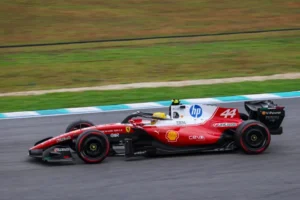
Then it got silly. On the first formation lap, polesitter Max Verstappen reported a loss of power, and Lewis Hamilton’s Ferrari developed throttle problems and stopped on the back straight. Ferrari-powered Haas and Cadillac cars also stopped briefly, and Race Control suspended the start. The FIA later called the glitch “unprecedented” and issued engine software tweaks. For those keeping score, that is a 2026 power unit, one of the most expensive pieces of engineering ever built for motor racing, being defeated by a bug.
Martin Brundle called it one of the craziest races he’s ever seen, and he’s seen a few. The chequered flag fell almost three and a half hours after the scheduled start.
Ferrari’s Tyre Masterclass (Of What Not to Do)
By the time the race restarted, the rain had stopped, and the track was drying. This is where F1’s finest strategic minds earned their salaries. Thirteen of 22 drivers, including both Ferraris and both McLarens, gambled on slicks. Verstappen and both Mercedes stayed on intermediates.
The track was not ready. It was too slippery for slicks even on the way to the grid, and Piastri and both Audis dived back in for intermediates. Ferrari carried on regardless, and Hamilton and Leclerc plummeted towards the back, more than a minute off the lead. Hamilton had been down in 18th. Hamilton had started on the front row and felt he could have challenged Verstappen for the win without the slicks decision. Instead, he spent the opening laps being lapped by his own ambitions.
Then the safety car saved him. Bottas spun his Cadillac on lap nine, the pack closed up, and Hamilton told the pit wall to wait for the track to dry rather than pit for intermediates as Leclerc had. He then set a blistering pace. He passed Isack Hadjar after the late restart to take third and end Ferrari’s five-race podium drought. Leclerc recovered to fourth. It was a great drive. It was also a drive he only needed because of the decision that put him there.
And the Winner Is… the Man Who Was on Pole
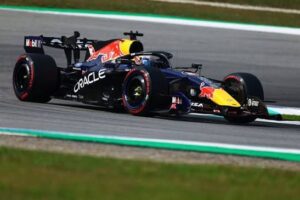
Verstappen did what he does. He lost the lead to both Mercedes off the line, then passed Russell on lap six and took Antonelli after the first safety car. By the late stages, he had built a lead of more than 10 seconds. A second safety car, with nine laps to go after Alex Albon’s stranded Williams, bunched everyone up again, but Verstappen made no mistakes on the restart.
The numbers matter here. It was his first win of the season and the 72nd of his career, and Red Bull’s first since Abu Dhabi 2025. It was also the first victory for Red Bull Ford Powertrains and the first for a Ford-powered car since the 2003 Brazilian Grand Prix. Verstappen was suitably chuffed, noting that winning in your first year with your own power unit is “pretty impressive”. He’s right.
The Rest of the Carnage
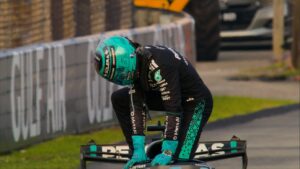
Kimi Antonelli finished second. His teammate George Russell, though, had a day to forget. He was running third with five laps to go when a suspected power-unit failure stopped him under the second safety car. His deficit to Antonelli is now a season-high 84 points with only seven rounds left, a week after he won in Baku. That title fight now looks about as open as a bank vault.
Elsewhere, Lando Norris was running seventh, then misjudged his braking at Turn One under the safety car and slithered through the gravel to ninth. Fernando Alonso claimed a season-best eighth for Aston Martin. Piastri was sixth, Lawson seventh, and Arvid Lindblad tenth.
The Verdict
F1 asked a Malaysian circuit to host a Bahraini race with ten weeks’ notice, in the monsoon season, with engines that crashed their own software. By any sensible measure, it should have been a disaster. What we got was the most entertaining race of the year.
The Singapore Grand Prix, with the season’s final Sprint, follows immediately. Let’s hope the weather and the software behave. They won’t, and I can’t wait.