The Alien franchise has always lived in two worlds: primal horror and cosmic philosophy. Ridley Scott’s Prometheus (2012) and Alien: Covenant (2017) leaned into the latter, exploring the Engineers, creation myths, and the Xenomorph’s bioengineered origins. While bold, those films left fans divided, with many yearning for a return to the claustrophobic terror that made Alien (1979) legendary.
Enter Alien: Earth, a new Disney+ and FX series that shifts the franchise back to its roots. Created by Noah Hawley, it tells a chilling new story set in 2120, only two years before the original Alien film. The result is a gripping, gorgeously produced series that bridges franchise canon while daring to introduce unsettling new themes.
Canon Placement – Between Nostalgia and Reinvention
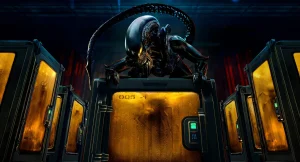
Unlike Prometheus and Covenant, which attempted to reframe the entire mythos, Alien: Earth resists over-explaining the Xenomorph’s origins. Instead, it treats the alien creature as it was first imagined: an apex predator, primal and terrifying.
The show is deeply embedded in the original continuity. By setting the events just before Ellen Ripley’s doomed voyage aboard the Nostromo, it positions itself as a narrative neighbour to Scott’s classic film. The story largely sidesteps the Engineers and their creationist lore, focusing instead on humanity—its greed, ambition, and fragility. In doing so, it both honours the canon and reframes it, stripping away mythology to remind us why the Xenomorph was frightening in the first place.
Storyline and Themes
At the heart of the series is Wendy (Sydney Chandler), a hybrid being: a synthetic adult body implanted with the consciousness of a terminally ill child. Guided by Boy Kavalier, she joins a group of other altered children known as the “Lost Boys.” Together, they grapple with existential questions of identity, mortality, and humanity’s relentless pursuit of technological immortality.
The plot kicks into high gear when the Weyland-Yutani vessel USCSS Maginot crashes into territory controlled by rival megacorporation Prodigy. What begins as corporate espionage quickly unravels into full-scale horror as the group encounters Xenomorphs and grotesque new alien forms.

Thematically, the series explores:
Immortality vs. Humanity – corporations pushing the boundaries of synthetic life and genetic manipulation. A concept that is not too far off from where we are currently headed.
Corporate Dystopia – five mega-companies competing for control, echoing today’s anxieties about tech monopolies.
Identity and Survival – Wendy and the Lost Boys’ search for belonging in a world where even humanity feels disposable.
It’s both philosophical and brutal, balancing moral dilemmas with sudden bursts of body horror.

CGI and Visual Design
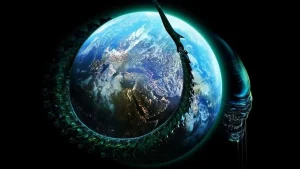
Visually, Alien: Earth is a triumph. The production design honours the industrial, “lived-in” aesthetic of the original films, with dark corridors, flickering lights, and suffocating spaces that ooze atmosphere.
The creature effects strike a balance between nostalgia and innovation. The classic Xenomorph returns in terrifying detail—its movements, textures, and sound design rendered with visceral precision. At the same time, new alien lifeforms bring shocking, grotesque variations that elevate the horror factor.
Disney also rolled out an immersive companion experience for Apple Vision Pro and Meta Quest, letting fans explore key environments in panoramic VR. It’s an ambitious extension that underscores the cinematic quality of the visuals.
Cast and Performances
Sydney Chandler shines as Wendy, delivering a performance that feels both vulnerable and otherworldly. The supporting cast lends weight to the morally complex roles, embodying corporate coldness, desperation for survival, and childlike innocence within synthetic shells.
While the series emphasizes atmosphere and philosophy over star power, its performances ground the spectacle with believable human stakes.
Comparison to Prometheus and Covenant
Where Prometheus and Covenant sought to reinvent the Xenomorph’s backstory, Alien: Earth strips things back to basics.
While Prometheus/Covenant steered us in the direction of engineering and alien gods, and the search for divinity.
Alien Earth switches it (back?) to a more primal nature, that of an apex predator. It’s focus on nature and its design may be a simplified notion, but one that strikes greater fear. By narrowing its focus, the series delivers a purer, more terrifying Alien experience while still raising new questions about what it means to be human.
Final Verdict
Alien: Earth is the most confident entry in the franchise since James Cameron’s Aliens (1986). It honours the horror and dread of the original while updating the visuals and themes for modern audiences. By grounding the Xenomorph in primal fear and shifting the spotlight onto humanity’s moral corruption, Noah Hawley has reinvigorated the franchise without overcomplicating its mythology.
Not flawless but undeniably ambitious, Alien: Earth reminds us why the Alien saga endures: in the cold dark of space, the greatest monsters are both alien and human.
Rating: 4.5/5 – A must-watch for fans of sci-fi horror and anyone who felt the series had lost its way.