Let’s get one thing out of the way immediately: the Mortal Kombat film franchise has had a rougher journey than most of its characters’ spinal columns. You had the gloriously cheesy 1995 original that somehow worked. Then Mortal Kombat: Annihilation in 1997 came along and performed a fatality on everyone’s faith in Hollywood adaptations — a movie so legendarily bad it currently sits at a 4% on Rotten Tomatoes, which is genuinely impressive in its own horrifying way. Then 2021 gave us a reboot that was… fine? Enjoyable, even? But also featured a man named “Cole Young” whom nobody asked for and nobody has thought about since.
Now, in 2026, we finally have Mortal Kombat II, and the big question is: does it stick the landing, or does it fall into the Pit and get impaled on those spikes at the bottom? The answer, much like the franchise itself, is complicated
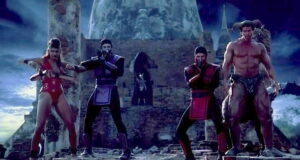
The Ghost of Kombat Past: How Do We Get Here?
To understand Mortal Kombat II, you really do need to appreciate the mountain of mediocrity it’s climbing over. The 1995 original, directed by Paul W.S. Anderson (yes, the Resident Evil guy, patron saint of video game movies of questionable merit), is still — remarkably — considered the gold standard of this franchise. It had a corny synth soundtrack that absolutely slapped, Christopher Lambert playing a god of thunder with a French accent because sure, and a genuine sense of fun that somehow made it work. It earned $122 million worldwide on a modest budget and launched a soundtrack album that people still unironically listen to in gyms. That movie knew exactly what it was: a glorified arcade game with humans in it, and it leaned in hard.
Annihilation then tried to shove every single character from the second game into 95 minutes, resulting in a film with the narrative coherence of someone button-mashing on a controller while blindfolded. It made $51 million and killed the live-action franchise for 24 years. Twenty-four years. The franchise needed almost a quarter-century of therapy.
Then 2021’s Mortal Kombat reboot arrived. It had impressive fight choreography, genuinely great gore (finally, a proper R-rating), and solid performances — but it was bogged down by Cole Young, an original character essentially created as an audience surrogate who ended up being about as interesting as watching the loading screen. Critics gave it 55% on Rotten Tomatoes, audiences gave it 85%, and everyone agreed the sequel needed to step it up.
Enter Mortal Kombat II.
What’s New in the Outworld: The Plot (Such As It Is)
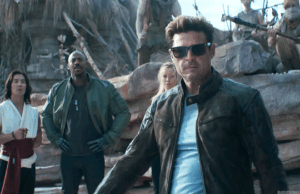
The film picks up after the events of the 2021 film. Shao Kahn — the massive, hammer-wielding emperor of Outworld who makes most Bond villains look understated — is calling for the final Mortal Kombat tournament. Win it, and Earthrealm survives. Lose, and Shao Kahn basically gets to do whatever he wants to us, which, judging by his personality, probably isn’t good for property values.
Lord Raiden is scrambling to assemble Earth’s champions, and he’s found the last piece of the puzzle: one Johnny Cage, washed-up Hollywood action star, martial arts champion, and professional narcissist. Johnny is, at this point in his life, doing sad fan convention appearances — the kind where he’s sitting alone at a folding table with a sad banner and a stack of glossy headshots nobody’s buying. Raiden basically shows up and says “hey, want to fight interdimensional monsters to save the planet?” and Johnny, having nothing better going on, says yes.
Meanwhile, Kitana — the adopted daughter of Shao Kahn, princess of the conquered realm of Edenia — gets a proper origin story in a flashback opening that mirrors the Scorpion sequence from the 2021 film. It’s effective, emotional, and actually sets up a character who matters throughout the movie, which is already a step up.
The Good Stuff: Where the Film Actually Throws a Punch
Let’s start with the obvious: Karl Urban as Johnny Cage is an absolute gift to this franchise. Urban plays Cage with the perfect blend of arrogance, self-deprecating charm, and genuine heart. He’s funny without being annoying, cocky without being insufferable, and when he eventually gets serious, you believe it. Cage has always been the comic relief character in the games, and the film walks that tightrope admirably. Urban’s casting is the kind of decision that, in hindsight, feels so obvious you want to ask why it took this long.
Adeline Rudolph as Kitana is equally impressive. Her role as the emotional anchor of the film gives the story whatever weight it has, and she carries it well. The chemistry between Cage and Kitana is one of the film’s unexpected highlights — two very different characters finding common ground while trying not to get disemboweled.
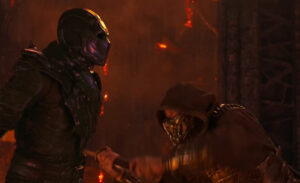
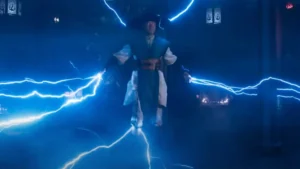
The fights are spectacular. The action choreography is consistently strong, leaning on practical stunt work fused with stylized CGI environments ripped straight from the games. Fans will absolutely lose their minds at the faithful recreations of iconic stages — The Pit, The Dead Pool — rendered with genuine love for the source material. The fatalities are creative, brutal, and delivered with the kind of enthusiastic commitment that makes you forget you’re watching something deeply ridiculous.
Speaking of fan service: franchise co-creator Ed Boon makes a cameo appearance, which is the kind of touch that suggests the filmmakers actually care about the IP and aren’t just collecting a paycheck. There’s also a welcome return from Josh Lawson as Kano, who remains hilariously awful in the best possible way. His snappy one-liners and gleeful awfulness make him the most reliably entertaining character in the new continuity.
The film also course-corrects one of the 2021 movie’s biggest problems by sidelining Cole Young to a background role. Nobody weeps. The film immediately improves.
The Not-So-Good Stuff: Where It Drops the Controller
Here’s where we need to be honest with ourselves, and with the good people of Outworld. The story is paper-thin. Critics have described the narrative as “largely nutrition-free,” which is a polite way of saying it’s the cinematic equivalent of rice cakes. The script, by Jeremy Slater, rockets through plot points at a pace that suggests someone bet him he couldn’t cover three video games’ worth of lore in under two hours. The result is that characters frequently meet, fight, and form alliances without adequate setup. Almost every fight is between combatants who have essentially just met. It’s less a story than a series of elaborate excuses to get to the next fight scene, which — to be fair — is kind of what the games are, but you expect a movie to at least pretend to have a plot.
Johnny Cage is criminally underserved by the script in terms of setup. Urban is fantastic, but the film barely introduces him before tossing him headlong into the tournament. There’s an hour’s worth of character development clearly left on the cutting room floor. We get hints of who he is — the washed-up star, the man desperate for meaning — but it always feels like we’re getting the abridged version when we want the full story.
Scorpion and Bi-Han (Sub-Zero) are here, but why? Their appearances are fun in isolation, but their inclusion is completely unearned. Hiroyuki Sanada is a tremendous screen presence, and yet the film keeps finding new ways to not use him properly. At this point, one has to wonder if the filmmakers simply cannot figure out how to integrate Scorpion meaningfully into a feature film, or whether the production simply cannot afford to keep Sanada on screen for more than fifteen minutes. Either way, it’s genuinely frustrating.
The CGI is uneven. Some of the fantastical realm-hopping looks genuinely impressive. Other moments look like they were rendered on a gaming PC from 2019. For an $80 million budget, you’d expect more consistency.
The pacing is all over the place. The film whiplashes between self-aware comedy and hyper-violent action so quickly that tonal whiplash becomes a recurring problem. One critic aptly described it as a film with “two tones it whiplashes between: Isn’t-this-all-so-ridiculous? wisecracks and excessively bloody violence.” Which is fair — and also, again, kind of what Mortal Kombat is — but better writing could have made those transitions feel intentional rather than accidental.
Versus Screen: How Does It Stack Up?
So where does Mortal Kombat II land in the franchise hierarchy? Here’s the ruthless breakdown:
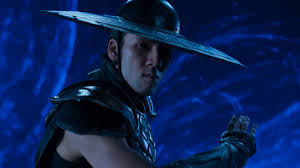
The 1995 original still sits on the throne. Nostalgia plays a part, sure, but Paul W.S. Anderson understood that you don’t fight the inherent silliness — you embrace it. Collider’s own critic noted that the 1995 film remains the franchise’s benchmark, and after watching this sequel, it’s hard to disagree.
Mortal Kombat II is comfortably better than the 2021 reboot, which itself was miles ahead of the 1997 Annihilation dumpster fire. The sequel has a 74% critics score on Rotten Tomatoes — the highest ever for a live-action MK film — and a scorching 90% audience score. That gap tells you everything: critics see the structural problems; fans see Karl Urban punching things in stylized arenas and simply do not care. Both reactions are valid.
Flawless Victory or Finish Him?
Mortal Kombat II is not a flawless victory. It’s a split decision — the kind of fight where both combatants land significant blows and you’re not entirely sure who won until the judges’ scorecards come in. It fixes real problems from its predecessor (Cole Young’s reduced role, the lack of an actual tournament, the failure to introduce fan-favorite characters), while creating new ones (thin story, rushed setup, uneven pacing).
But here’s the thing: it’s fun. Load up the popcorn, accept that you’re not watching Citizen Kane, and revel in Karl Urban being magnificent, Kitana being badass, Kano being awful in the most delightful way, and fatalities that would make a surgeon both horrified and professionally curious. It knows what it is. It delivers what the audience came for. And for the first time in the history of this live-action franchise, it’s actually gotten the proportions right enough to make a sequel worth watching.
Mortal Kombat 3 is already in development at Warner Bros. If the filmmakers take the lessons of this film seriously — more character depth, tighter script, resist the urge to cram in every character from the roster — the franchise could finally, truly, achieve that flawless victory.
For now, Mortal Kombat II earns a solid: Flawed But Enjoyable. Like most of its characters, it’s battered, a little broken, but still standing.
INSERT COIN: Street Fighter vs. Mortal Kombat II – NERDGASM %%post_title%% | Nerdgasm