It’s been widely rumored that the much-maligned Multiverse Saga will end with a soft reboot of the Marvel Cinematic Universe, injecting fresh blood into the almost 20-year-old film franchise. One of the significant differences with this new MCU will be the introduction of a new cinematic X-Men roster. As much as I’m excited for this new take on the Children of the Atom, I’m hoping we also get to see another Marvel team get a much-needed do-over.
James Gunn
While James Gunn did a pretty decent job in adapting the Guardians of the Galaxy for Marvel Studios, he also took several liberties with the characters and their established mythology. While Rocket and Groot are pretty much spot on, the same cannot be said for the other members of the team. Nebula is not Gamora’s sister (adopted or otherwise), Ego is not Starlord’s dad, Yondu is not a space redneck, the High Evolutionary did not make Rocket Raccoon, and so on. For every bit that’s comic-accurate, there’s also a lot that deviates from the source material. So let’s explore exactly how Gunn’s versions of these characters differ from their comic iterations and why some of these changes were so disappointing.

Peter Quill:
While aesthetically, James Gunn’s Peter Quill is pretty spot on, from his trademark burgundy jacket to his retro-futuristic mask, there are some distinct differences once you dig below the surface. As previously mentioned, the space-faring Quill is not the son of a sentient planet. In the comics, he is the son of an aristocrat named J’Son of Spartax and is the heir to his father’s powerful space empire. He even has a half-sister named Empress Victoria. Gunn was not a fan of this origin story however and opted to go in a completely different direction for the film. Additionally, the Element Gun, Quill’s signature weapon in the comics which discharges any of the four elements, is nowhere to be seen in the films, with Gunn claiming that he feared the weapon’s novelty would overwhelm moviegoing audiences.
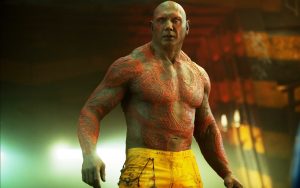
Drax:
What may come as a surprise to a lot of non-comic readers is that Drax is human in the comics, or originally was. Born Arthur Douglas, he was turned into Drax the Destroyer by Thanos’ granddad Kronos for the sole purpose of killing the Mad Titan, and he succeeded (albeit after multiple failed attempts). Suffice to say, Drax was a total bad ass in the comics, not some slack-jawed, comic relief, joke character that gets his ass handed to him by almost everyone he comes across. Even Dave Bautista expressed his disappointment in Gunn’s treatment of the character, whom he was initially very excited to play after reading up on him. This is especially disappointing given that Bautista’s physicality was perfect for the role and yet this was squandered in favour of a more uninspired, dumb brute stereotype that hardly lives up to his “Destroyer” epithet.
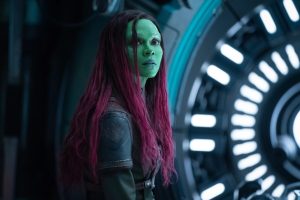
Gamora:
Why is Gamora (so poorly adapted in the MCU)? Gamora is probably the closest thing Marvel has to Wonder Woman in the comics. After all, she’s known as the Deadliest Woman in the Universe for good reason. She is one of the best hand-to-hand combatants in the entire Marvel universe, has Spider-Man-level strength and durability, cybernetic augmentations thanks to genocidal stepdad Thanos, and a Wolverine-level healing factor to boot. Add to this an insatiable blood lust and take-no-prisoners attitude, and we have someone who’s very far removed from the irritable but otherwise vanilla character she’s portrayed as in the films.

Adam Warlock:
For a character teased not once but twice in the Guardians of the Galaxy films, Adam Warlock’s debut in volume three was anticlimactic, to say the least. Fans waited years just to see one of the most fascinating and complex characters in Marvel history reduced to a completely witless, one-dimensional, Superman parody. By contrast, the comic version of Adam Warlock is perhaps more akin to the MCU’s Vision. He is incredibly formidable but also surprisingly wise, intuitive, and enigmatic, and is also a frequent bearer of the soul stone, much like Vision himself (in the MCU, that is). Gunn would later say that he did not know how to write the character but felt obligated to do so because he teased him in the previous film’s post-credit scene. An odd excuse considering the tease was his idea to begin with, but it is not particularly surprising given how badly the character was portrayed.
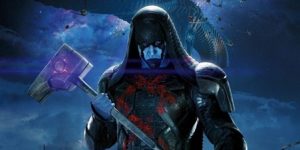
Ronan:
Much like Adam Warlock, Ronan is yet another complex character that’s watered down to the point of caricature. Unlike the one-note, moustache-twirling villain that he’s portrayed as in the films, the “real” Ronan is far more nuanced, and more morally ambiguous rather than downright evil. Though the character began as a Fantastic Four antagonist, Ronan has collaborated with several superheroes over the years (including the Guardians themselves) and is even a card-carrying member of the Annihilators – essentially the cosmic Avengers – alongside Silver Surfer, Gladiator, and Beta Ray Bill amongst others. Even more bizarre than the character’s cartoonishly evil portrayal in the film is how powerful he’s depicted as being. While he is no slouch, Ronan is certainly not taking on an entire Guardians team by himself. In fact, in the comics, the character fared rather poorly against just Gamora alone, who gave him quite a humiliating beatdown when the two crossed paths.
Secret Wars
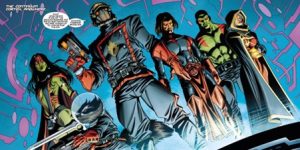
One hopes that following Secret Wars, we can have a renewed take on the Guardians, much like how Gunn’s own Suicide Squad reboot gave us a reinvigorated and more faithful depiction of the titular team.
Another disappointing aspect of Gunn’s films is his disinterest in adapting major event titles from the comics in favour of original narratives, which while allowing for completely new stories, rules out adaptations of iconic projects featuring the team such as War of Kings, Thanos Imperative and Annihilation: Conquest, all of which could have made for truly epic cosmic adventures with high stakes and greater implications for the Marvel universe at large.
With all of this in mind, there is plenty of room for a completely fresh direction for this franchise going into the rejuvenated post-Secret Wars MCU, one that leans closer to the source material and allows the Guardians to truly be the mythical, larger-than-life characters that they were meant to be.